JOIN US
Join our community!
Sign up to our newsletter to hear about the latest
special offers and news, exciting projects and events.
Welcome to the world of Beaumier.



{{responseMessage}}
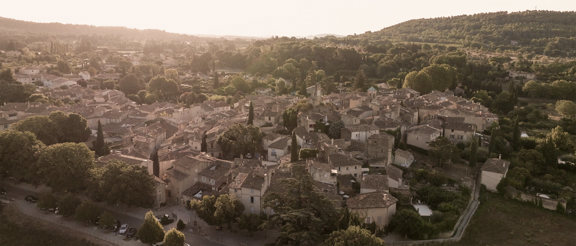
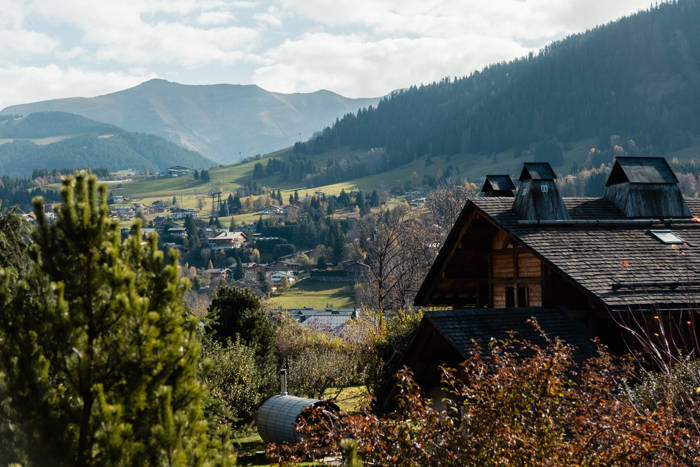
Lourmarin sits quietly in the south of the Luberon, where the mountains fold open and the landscape softens into olive groves, vineyards and dusty stone. Listed among France's most beautiful villages, it earns the title without trying. Writers settled here. Albert Camus and Henri Bosco are both buried in the village cemetery. Nobel Prize money built a house. And on any Friday morning, half of Provence seems to find its way to the weekly market, baskets in hand. Whether you arrive for a morning or stay for several nights, Lourmarin tends to hold you longer than planned.
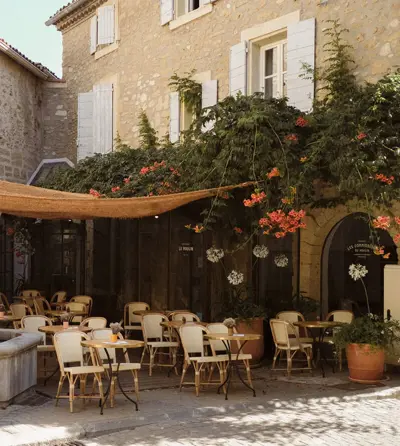
Lourmarin is a village best discovered on foot, without a plan. Start at the central square, where café terraces spill out onto the cobblestones and the morning light falls across stone facades. Follow Rue du Temple towards the château, then lose yourself in the smaller streets that branch off it — narrow, quiet, lined with old houses whose shutters come in every shade of blue and green. Stop for a café crème. Sit for longer than you intended. There is a boulangerie producing gibassier, the Provençal olive oil biscuit, best eaten still warm. A tea shop tucked off the main route, with a garden terrace built for reading. A free wine tasting at Domaine de Fontenille, right on the village square.
The French have a word for this: flâner. Lourmarin was made for it.
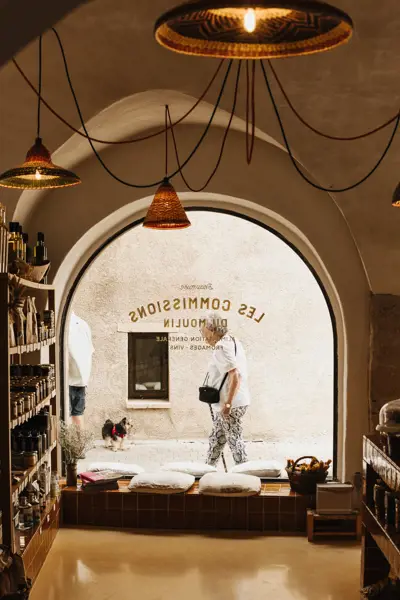
The village has a concentration of independent boutiques that rewards an unhurried browse. The streets around Rue du Temple and Place Henri Barthélémy are where most of them cluster — linen shops, ceramics, olive wood, hand-poured candles, local honey and lavender products. Several galleries show the work of regional artists and change their exhibitions through the season. On Friday mornings, the market itself is the best place to find Provençal craft alongside the produce: handwoven baskets, artisan jewellery, printed fabrics. Nothing is rushed. The shop owners tend to know their stock well and are glad to talk about it.
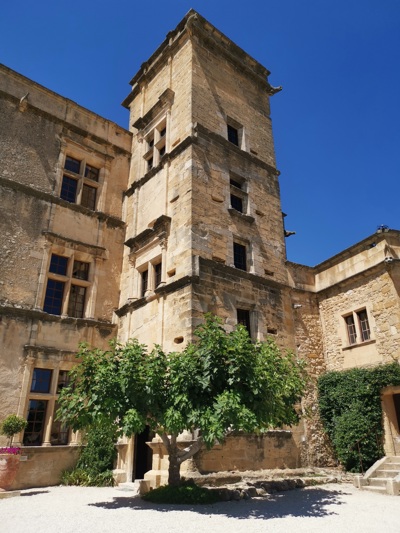
The oldest Renaissance château in Provence is also one of the most unlikely stories in it.
In 1920, a Lyon entrepreneur named Robert Laurent-Vibert used his family fortune — built on the men's hair product Pétrole Hahn — to rescue the château from demolition and restore it stone by stone. His condition: that the building serve young artists in perpetuity. The Académie des Sciences, Agriculture, Arts et Belles Lettres of Aix-en-Provence has overseen it ever since.
Inside, you will find period rooms, a remarkable spiral staircase and a calendar of concerts, exhibitions and art residencies that continues through the seasons. The terrace is worth the climb alone: from there, the village spreads below and the Luberon stretches out behind it.
Plan an hour to an hour and a half. The château is open year-round, though guided visits vary by season.
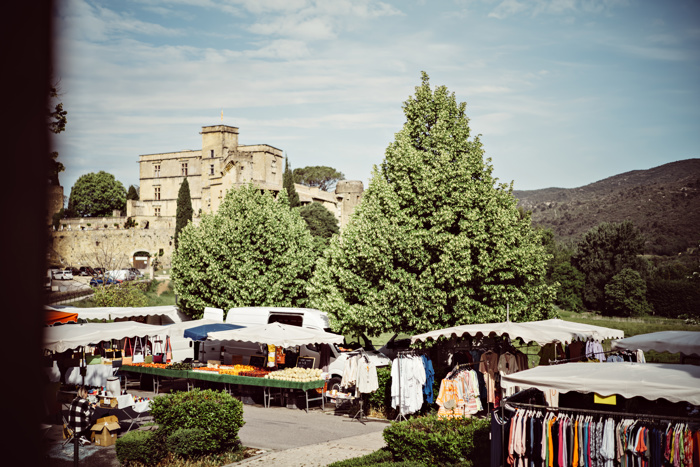
Every Friday morning, from 08:30 to 13:00, year-round.
Lourmarin's market is widely considered one of the finest in the Luberon. It fills the village streets with stalls of fresh produce, olives, tapenade, aged cheeses, linen cloth, lavender sachets and handmade jewellery. The rhythm of it — slow, unhurried, fragrant — is as much the point as anything on the stalls.
In July and August, go early: the market draws real crowds and the heat is felt by mid-morning. Out of season, the atmosphere is calmer and more local. And whatever day you arrive, the terraces of Lourmarin's cafés are worth a slow hour — a café crème, a gibassier from the boulangerie, the morning light coming in sideways.
Albert Camus chose Lourmarin partly because its mountains recalled his native Algeria. He described the landscape as "solemn and austere despite its bewildering beauty." With his Nobel Prize money in 1957, he finally bought a house on Rue de l'Église, just steps from the village centre — a place he had been trying to reach for a decade, writing letters to poet friends asking them to help him find somewhere to live here.
He died in a car accident on the road to Paris in January 1960, two years after arriving. He was 46. The train ticket he had originally booked was still in his pocket.
Henri Bosco, whose novels draw deeply from the landscapes and light of Provence, also made Lourmarin his home and is buried here too. The cemetery is a calm, unshowy place, a short walk from the market square. Their graves are simply marked. For those who know the work, it is a moving detour.
"The first star over the Luberon, the enormous silence, the cypresses."
The countryside around Lourmarin is wine country, and several domaines welcome visitors with tastings, walks and a chance to understand the terroir of the Luberon at close range.
A few steps from the village of Lourmarin, Château Fontvert is a family estate cultivated in organic and biodynamic agriculture. Its existence is attested as far back as 1598; today the vineyard extends across around fifty hectares, of which 20 to 25 are Demeter-certified. The estate receives visitors in a calm, preserved setting — tastings, discovery of biodynamic farming, walks through the vines. Open daily 09:00 to 12:30 and 14:00 to 17:30 (Sundays 15:30 to 18:30). Three minutes by bike from the village, 13 minutes on foot.
Also in the commune of Lourmarin, the Mas Arnal is a family-run organic estate of 8 hectares, its varied soils and renovated barrel cellar producing wines of real finesse. They also produce the Vin Beaumier — the house wine of the Beaumier hotels. Visits by appointment, for tastings in the company of the winemaker. Open Tuesday to Saturday, 10:00 to 17:00. Four minutes by bike, 8 minutes on foot.
Further afield, near Puget in the southern Luberon, Château La Verrerie is one of the appellation's most emblematic estates: 150 hectares of land, of which 56 are vines cultivated organically, on a site founded in the 1980s on the grounds of an ancient glassworks. The domaine offers a full oenotourism experience — walks through the vines, cellar visits, tastings of wines and olive oils in a refined setting. Open daily 10:00 to 13:00 and 15:00 to 19:00. 34 minutes by bike, 15 minutes by car.
Lourmarin sits roughly 40 kilometres from Aix-en-Provence and 60 kilometres from Avignon. A car is all but essential — the village has no train station and public transport connections are limited. The good news: both TGV stations have plenty of car hire options, making it straightforward to organise from any major French city. Parking is available in several lots around the village; on Friday mornings, aim to arrive by 08:00 to make the most of the market before the crowds.
Late spring and early September tend to offer the most rewarding conditions: extraordinary light, manageable crowds and the full range of restaurants and shops open. Lourmarin is also one of the few Luberon villages that remains active through winter.
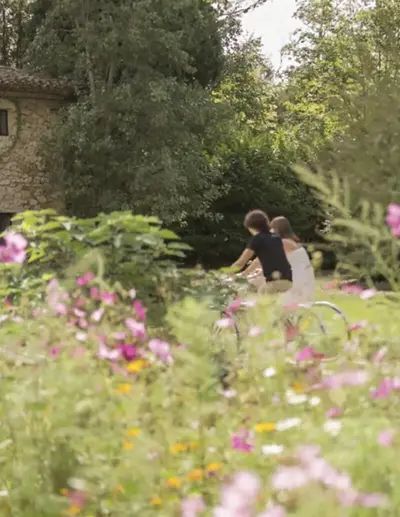
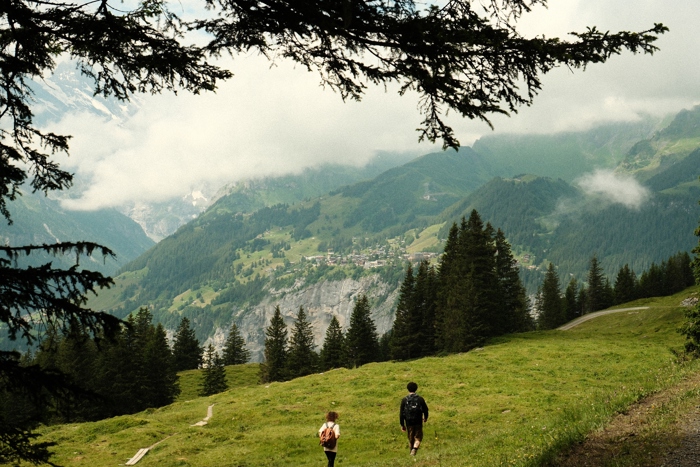
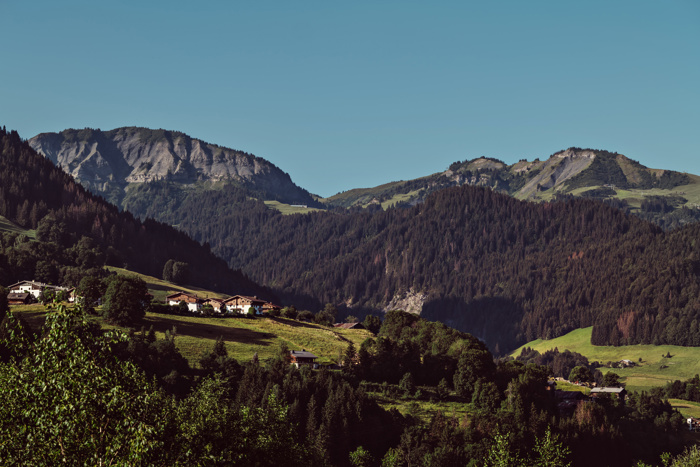
Lourmarin is a good base for exploring the countryside on foot or by bike. The trails of the Grand Luberon start almost from the village edge, winding through garrigue, dry-stone walls and cypress alleys before opening onto views that stretch to the Alps on clear days. For something more demanding, the Buoux site — about 15 kilometres east — is one of the most celebrated climbing spots in France, its limestone cliffs drawing enthusiasts from across Europe. Those who prefer two wheels will find quiet roads through the vineyards connecting Lourmarin to Cucuron, Ansouis and Cadenet with little traffic.
On Friday mornings from April to June and September to October, a guided market itinerary winds through the Lourmarin stalls with a focus on the best local producers — a good way to learn whose olive oil, whose cheese and whose honey is worth taking home. Later in the morning, the Château La Verrerie wine truck parks near the village square, offering tastings of estate wines alongside provisions from the local épicerie.
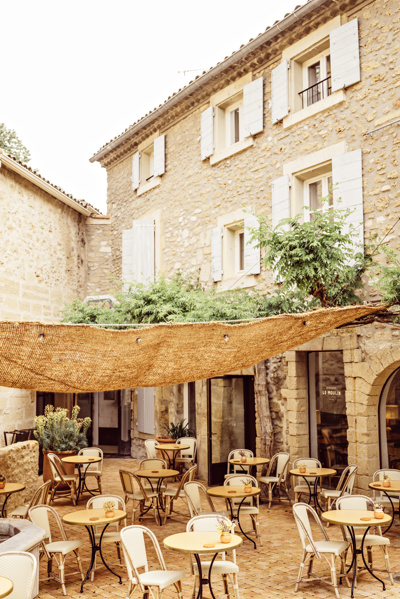
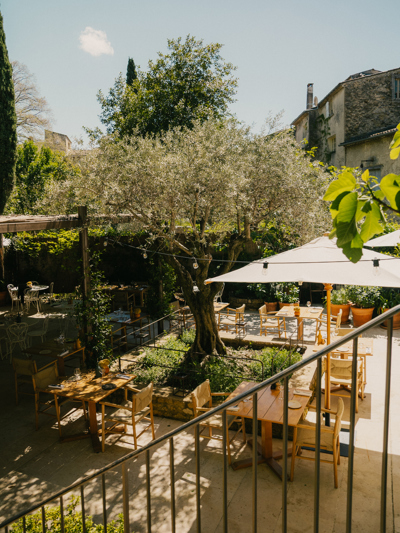
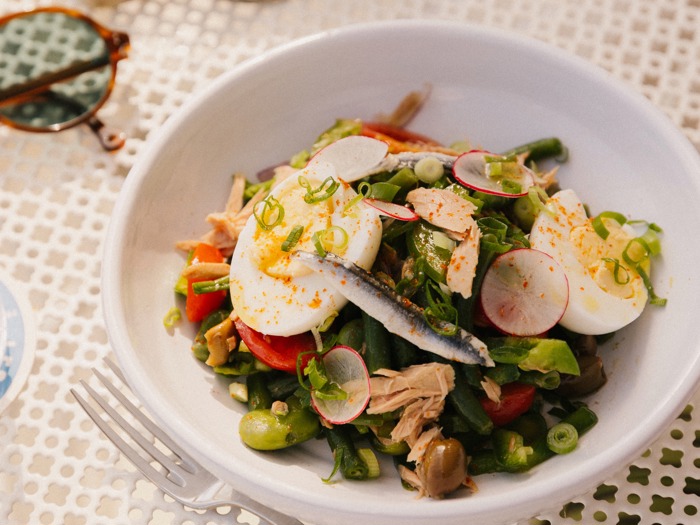
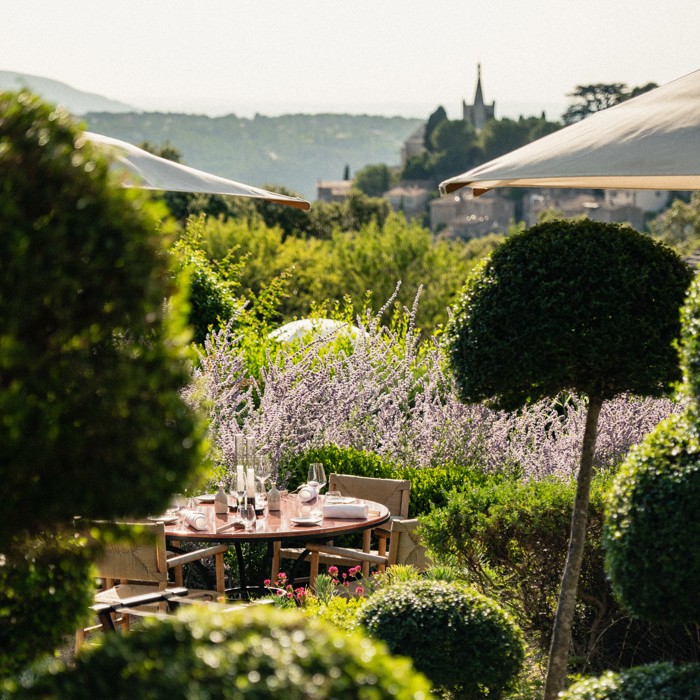
The village has plenty of places to eat, from a simple coffee on a terrace to a meal worth planning an evening around. For a restaurant in Lourmarin that reflects both the landscape and the season, Bacheto is the kitchen at Le Moulin de Lourmarin. It works with Provençal producers and adapts its menu to what grows nearby — cooking that makes the ingredients the point. The terrace, set in the converted mill courtyard, is one of the quieter spots in the village for an unhurried dinner.
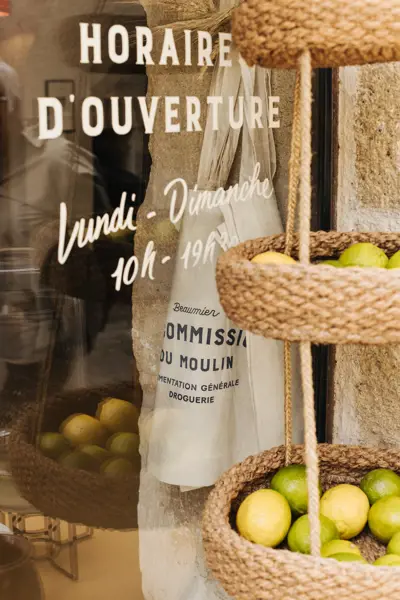
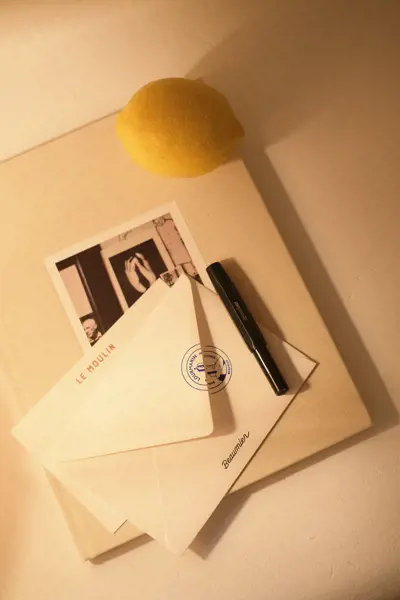
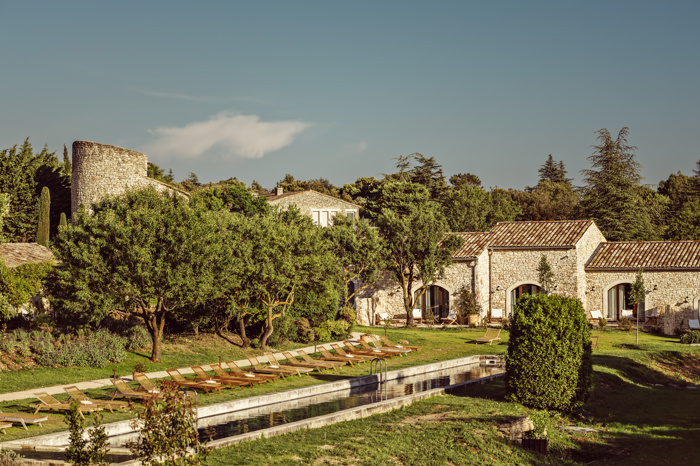
To stay in the heart of the village, Le Moulin de Lourmarin offers rooms set in a converted olive mill a few steps from the market square — a hotel in Lourmarin that places you at the centre of things from the moment you arrive. For something quieter at the edge of the village, Le Galinier is a Beaumier guesthouse — a B&B in Lourmarin with the unhurried rhythm of a private house.
Lourmarin is a village in the Luberon, Provence, listed among France's most beautiful. It is best known for its Friday market, Château de Lourmarin — the oldest Renaissance château in Provence — and its literary heritage as the final home of Nobel Prize-winning author Albert Camus.
Late spring (April to June) and early September offer the most pleasant conditions: good light, fewer crowds and the full range of restaurants and shops open. Lourmarin is also one of the rare Luberon villages that stays active in winter.
Yes. Lourmarin has no train station and bus connections are infrequent. A car gives you the flexibility to explore the surrounding villages and nearby vineyards. Both Avignon and Aix-en-Provence TGV stations have plenty of car hire options, making it easy to organise from the moment you arrive by train.
The main market runs every Friday morning from 08:30 to 13:00, year-round. In July and August, smaller evening markets also take place on some summer nights.
Cucuron, Ansouis, Bonnieux and Ménerbes are all within a short drive. The Combe de Lourmarin road connects the village to the north Luberon and is one of the most scenic routes in the region.
This site is protected by reCAPTCHA.